— Here a voice begins to tell the tale. —
The Telling · VIII
Done
They gave him bread and a coat that did not fit, and the gate was opened, and that was all the ceremony there was.
The Jester walked with him as far as the eastern road.
He had not stopped crying and he had not acknowledged that he was crying, and he kept making jokes into it, which is the bravest thing in this book.
'Stay,' he said. 'Be the second fool. I will teach you the falls. You have the face for it.'
'You do not need a second fool,' said the prisoner. 'You need somebody to tell you that you are not one. So: you are not one.'
'That is a terrible gift.'
'It is the only one I have left. I gave the rest to a King.'
The Jester stood in the road until the shape of him was gone.
Behind, in the hall, the Priest opened his book that night and read the same page nine times and shut it and did not sleep.
He would harden.
Some do.
The story had gone into him and found nothing to eat and had gone out again, and he would preach against wandering men for another twenty years with a slightly louder voice than before.
The Guard stayed.
He did not become gentle.
He became exact.
He began, without announcing it, to ask his eight hundred men why — not always, not kindly, but sometimes — and the ones who could answer he kept close, and the ones who could not he taught.
That is how it moves in a soldier.
Slowly, and in the right direction.
And the King ruled for another nineteen years, and was not a good King in the way of songs, and was a good King in the way that is only ever noticed afterwards, by people counting the things that did not happen.
He never told anyone the story.
He was not able to.
He tried, twice, and both times it came out as information, and he heard it come out as information, and stopped.
The shepherd went north.
It took him most of a year.
The valley was where he had left it, because valleys are.
The river was black at night and brown in the day, and the people there said it was silver, and he did not correct them, because he had learned by then that a thing can be brown and silver at once depending on who needs it.
There were sheep on the hill.
They were not his sheep.
His sheep were forty generations of grass by now.
These were somebody else's, and then for a while they were nobody's, and then they were his, because he was there and he fed them and nobody else came.
So he was a shepherd again, on the same hill, in the same rain, with the same animals, doing the same work, and everything about it was different, and nothing about it could be explained.
He had gone out to escape being led and come back to keep a flock.
He had believed that holding the stick placed him outside the flock, and had learned instead how easily a shepherd may follow without knowing it.
Now he knew how to lead without pushing, and how to stand among them without pretending he was one of them.
He grew old there.
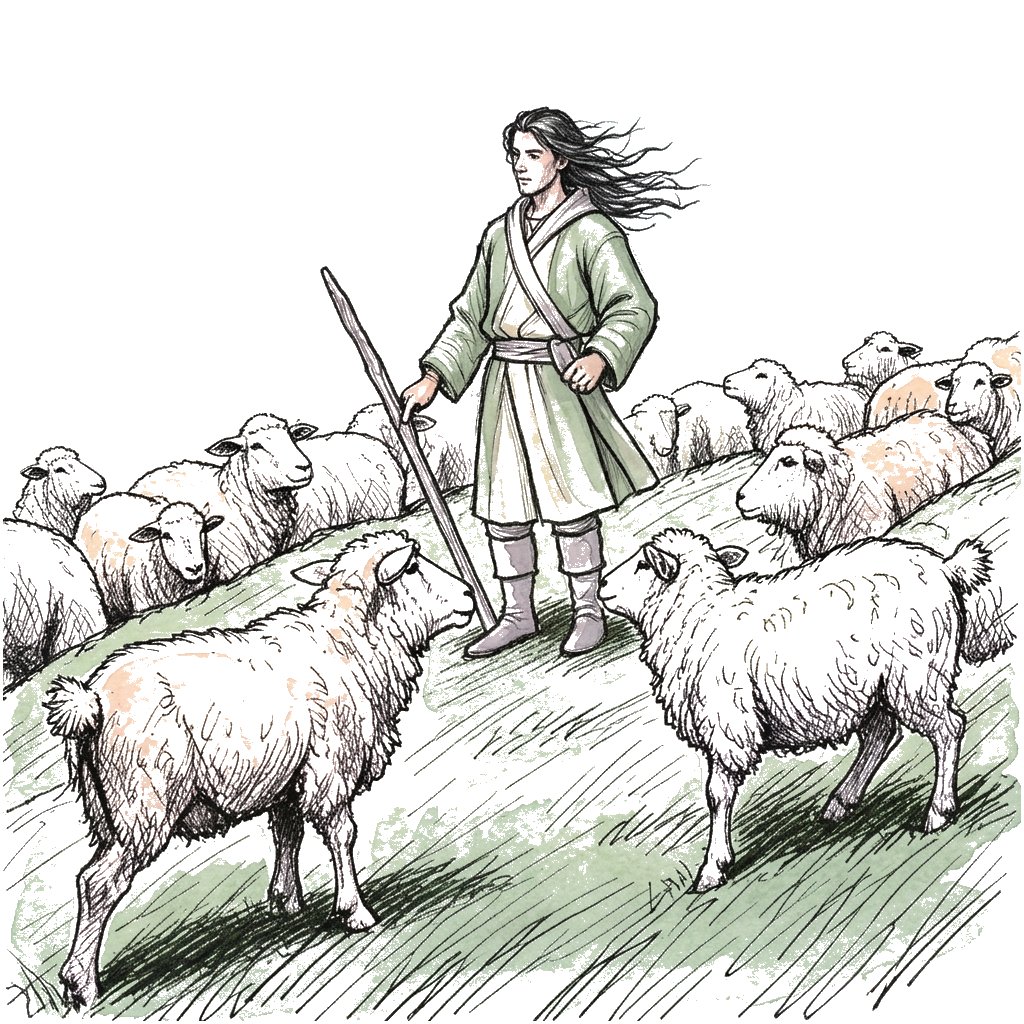
One evening, as the light was leaving the hill, the shepherd looked across the flock.
Near its far edge an old sheep had raised his head.
The shepherd knew him at once, though he could not have said how.
Heryshaf.
Neither spoke.
The wind moved across the hill, lifting the shepherd's hair and passing through Heryshaf's wool.
For a moment they looked towards the same horizon.
Then Heryshaf lowered his head and began to eat, and the shepherd smiled.
In the evenings the lambs came and lay near him because he was warm, and one evening one of them — a small one, with a black ear, the sort that always stands in the rain when there is a perfectly good tree — said:
'Tell it again.'
So he told it again.
The sheep at the river.
The uncle dying.
The eagle and the mountain and the queen under the ground.
The cell with the high window and the King who could not give the order.
And when he had finished, the lamb with the black ear said:
'But what was it? The meaning. What was the answer?'
The old shepherd did not say anything for a while.
The wind came up the valley and went through the grass and through the fleece of two hundred sheep and through him, and he felt it, and he noticed that he felt it, and that the air in his lungs was cold and clean and finer than it had any right to be.
'That,' he said, 'is not a thing I can tell you.'
'Because it is a secret?'
'No,' said the old shepherd. 'Because telling is not knowing. I could put it in your ears in four words and you would have four words.'
The lamb thought about this with the terrible seriousness of the very young.
'Then how do I get it?'
The old shepherd looked down the valley, where the river was going black, and the first star was out, and eleven thousand evenings had happened exactly like this one and he had been present for perhaps nine of them.
'You are getting it now,' he said.
'Do not be sheep.'
And then, because he was old, and because it was true, and because there was nobody left alive who would misunderstand him:
'Be a very good sheep.'
The lamb did not understand.
The lamb would understand, in about forty years, on a hillside, with a lamb of its own.
That is how it travels.
It has never travelled any other way.