The Telling · VII
Silence
The morning came the way mornings do, without any sense of occasion.
There had been no order given.
That was the strangeness of it.
The machinery of the thing had simply continued to turn, because it had been set turning forty-one days earlier and nobody had thought to stop it, and so at dawn the Guard came down the stairs with two men, and the prisoner stood up.
'There has been no order,' said the Guard.
'There has been no order to stop, either,' said the prisoner. 'Let us not make anybody's morning difficult.'
They came out into the yard.
The court had assembled without being summoned, which nobody remarked upon.
The Priest was there with his book shut.
The Jester was there with nothing in his hands at all, which for him was a kind of nakedness.
The King stood on the step.
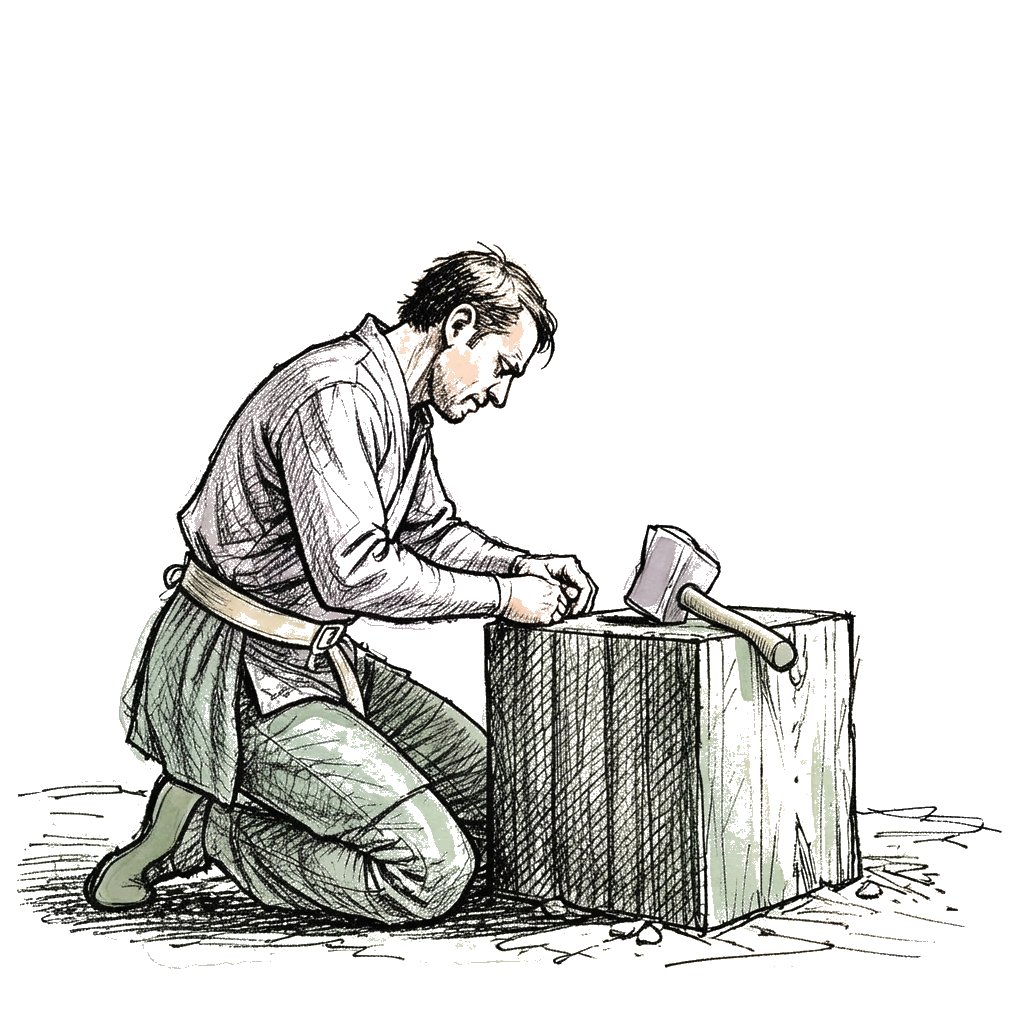
The block was old and pale and had a shine on it in one place.
'You may speak,' said the King.
His voice was not steady, and he heard it not being steady, and hated it.
'I have spoken for forty-one nights,' said the prisoner. 'You have all of it. There is nothing left in me that has not been handed over.'
He walked to the block.
Nobody had taken his arm.
That was what the Jester remembered afterwards, and told badly, in taverns, for the rest of his life: nobody took his arm.
The prisoner knelt.
He did not kneel the way the condemned kneel, which is a sort of falling that has been arranged in advance.
He knelt the way a man kneels to drink from a stream.
He put his cheek against the cold stone and let out a long breath.
The breath went out of him completely, and he did not draw another quickly.
And in that moment he understood the last thing, and it was too simple to have been worth nine years, and it had cost exactly nine years.
He had wanted the meaning of life the way a man wants a stone he can carry in his pocket.
He had wanted to find it, hold it, own it, and — he saw this now, with his face against the block, and found it funny — to be the man who had found it.
That was the last thing he was still holding.
Not life. He had put life down weeks ago in a cell with a high window.
This.
The wanting to have an answer.
He let it go.
It went easily, which was the joke.
It had never been heavy.
He had only been gripping.
What was left was not an answer and not an emptiness.
It was the cold of the stone, and the smell of the yard, and eight hundred men breathing somewhere behind him, and the fact of a morning happening whether or not he was in it.
It was enormous.
It had been there the whole time.
'Now,' he said, to nobody, 'it is worth something.'
And the King, on the step, discovered that he could not do it.
Not would not.
Could not.
He opened his mouth to give an order he had given four hundred times, and the machinery of it was gone.
Every execution he had ever ordered had run on a single fuel, and he had never known it until the fuel was absent: they had all been afraid, and their fear had told him he was a King.
This man was not afraid.
There was nothing for the crown to grip.
And underneath the crown, where he had not looked in thirty years, there was a person, and the person had been standing in the dark the whole time waiting to be asked.
The Guard's hand was on his sword.
It had been on his sword since the yard door.
It did not move.
It would not have moved, and both men knew it, and neither ever said so.
'Get up,' said the King.
The prisoner got up.