2nd Interval
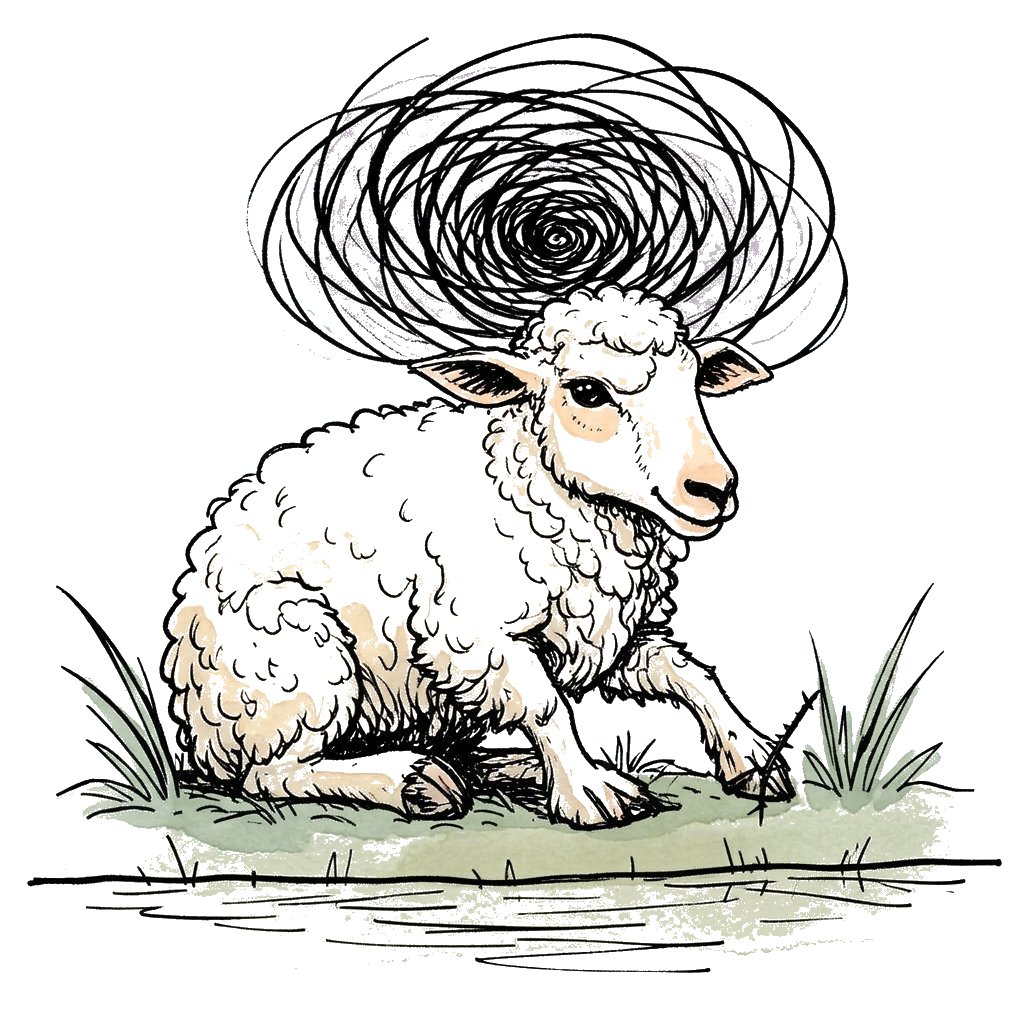
Heryshaf left the mountain in the distance, following a twisting river down the hill.
Somewhere along the path, a thorn worked its way into the soft part of his hoof.
At first it was hardly worth stopping for. He felt a small prick each time his hoof touched the ground, but he had walked on sore feet before and decided it would probably work itself loose.
It didn't.
The farther he walked, the more he noticed it. Every few steps it caught him sharply and made him wince.
He began putting more weight on his other legs, which made walking awkward, and soon he was limping along the riverbank.
'Oh, come on,' he muttered after one particularly painful step.
He stopped and rubbed his hoof against the grass, hoping to knock the thorn free. For a few steps afterwards it seemed better.
Then it stabbed him again.
Heryshaf gritted his teeth and carried on.
The little pain became a constant nuisance. He tried walking on the soft grass, then on the mud beside the river, but nothing helped.
With every sharp prick he became a little more frustrated, and with every frustrated step the journey seemed a little less pleasant.
Eventually he could stand it no longer.
Heryshaf sat down heavily beside the river, lifted his hoof and tried to pull the thorn out with his teeth. He could see the end of it, but whenever he caught it, it slipped away again.
He tried once.
Then twice.
Then a third time.
'Ow!'
Heryshaf stamped his good hoof into the ground.
'STUPID THORN!'
A fly buzzed around him and Heryshaf, frustrated, swooshed it away.
He tried again.
This time he caught the thorn between his teeth and, with one sharp pull, dragged it free.
'There!'
He spat it into the grass and got back to his feet.
The thorn was gone.
But his bad mood wasn't.
The river now seemed too noisy. The evening was too cold. The birds in the trees would not stop calling to one another.
Even the stones seemed to be lying in exactly the wrong places.
Then, almost without noticing, Heryshaf began thinking about the flock.
They had been fools to cast him out. They had never listened properly, and if they had only let him explain, they would have seen that he had been right all along.
Soon he was re-running his time with the flock in his head, saying all the clever things he wished he had said at the time.
He remembered every insult and every unfair word.
He imagined what he would say if he ever saw them again.
In these new arguments, Heryshaf always won.
Strangely, each victory only made him angrier.
By evening he was arguing with sheep who were not even there.
'You never listened to a word I—'
He stopped.
One hoof was raised in the air and he was glaring furiously at a willow tree.
For a moment, Heryshaf simply stood there.
Then something curious happened.
It was as though a small part of him stepped backwards and looked at everything that was going on inside him.
And a question came to him that he was quite certain he had not made himself.
It arrived the way a voice arrives in a hall that is supposed to be empty.
But how do you know?
'Who is angry?' he asked.
It seemed a silly question.
I am angry, he thought.
But when he looked more carefully, he found the anger was almost doing everything by itself.
It was hot and noisy and terribly certain that it was right.
And suddenly Heryshaf realised something else.
The thorn had started the anger — but the thorn was gone.
The anger was still there.
In fact, it was bigger than before.
Somehow it had begun feeding itself.
One angry thought led to another, and that thought found something else to be angry about. It gathered every old complaint it could find, every unfair word, every argument Heryshaf had ever lost, and rolled them all together.
By now the anger had grown very large indeed.
It had become a thing of its own — a great ball of frustration and nastiness rolling around inside him.
It had its own voice, its own thoughts and its own reasons for being angry.
It knew who was to blame.
It knew what Heryshaf should say to them.
It even knew what they would say back.
And the strangest thing was that, until this moment, Heryshaf had believed that voice was him.
He stood very still.
'You are not me,' he said slowly.
The anger did not like that at all.
At once it wanted to be let out. It wanted Heryshaf to shout at the sky, stamp his hooves and tell somebody — anybody — exactly how badly he had been treated.
He could feel how wonderful it would be to say everything he was thinking.
But he did not.
He did not shout, and he did not pretend the anger wasn't there.
He did not push it away or tell himself that he ought to be a good and forgiving sheep.
He simply stood beside the river and felt it.
The anger burned inside him, and Heryshaf watched.
For one whole minute he gave it nothing.
Not a word, not another argument, not even a quiet grumble.
It was harder than any mountain.
And then, quite suddenly, the storm began to pass.
The heat went out of it. The angry voice became quieter.
All the things it had been so desperate to say suddenly did not seem quite so important.
And in its place came a strange steadiness.
Heryshaf felt quiet and clear, as though someone had opened a little window somewhere behind his ribs and let cool air inside.
The flock had still cast him out.
Nothing about the past had changed.
Nothing in the world around him had changed.
And yet, when he took a deep breath, even the air seemed somehow finer.
Heryshaf knew that feeling.
He had felt it once before, beside his uncle.
Heryshaf looked back at the tiny thorn lying in the grass.
It was strange.
Such a tiny thing had started it all. But somewhere along the way the thorn had become a river that was too noisy, an evening that was too cold, birds that were too irritating, a flock that was too foolish, and finally a whole world that seemed to be against him.
And none of those things had been the thorn.
Heryshaf smiled.
Then he curled himself into the grass and slept without dreaming.
Beside him, the river went on towards the sea, quiet and unhurried.